
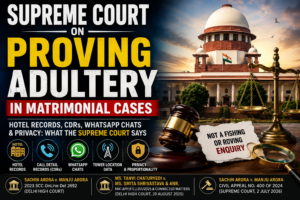
Can hotel records, Call Detail Records (CDRs), WhatsApp chats, and tower location be used to prove adultery in a divorce case?
This is one of the most common questions asked in matrimonial litigation. Since adultery usually takes place in private, direct evidence is rarely available. The Delhi High Court and, recently, the Supreme Court have clarified when Family Courts can direct production of hotel records, CDRs, WhatsApp chats, and other electronic evidence to establish adultery while balancing the constitutional right to privacy.
In this article, I explain the legal principles laid down in Sachin Arora v. Manju Arora, subsequently reaffirmed in Ms. Tanvi Chaturvedi v. Ms. Smita Shrivastava & Anr., and affirmed by the Supreme Court on 2 July 2026.
Burden of Proving Adultery in Matrimonial Cases
In matrimonial cases, direct evidence of adultery is rarely available. Spouses usually must rely on circumstantial evidence, which can be difficult to collect even when adultery has occurred. For example, a spouse may have admitted to the affair, but the other spouse may not have recorded the admission because of emotional distress or a lack of understanding of the legal implications. In any case, adultery must be proved before the court in accordance with law.
The alleged adulterer should ordinarily be made a party so that no decision is passed without giving that person an opportunity to be heard. The burden of proving adultery remains on the spouse who alleges it.
Recently, the Hon’ble Supreme Court, in Sachin Arora v. Manju Arora, Civil Appeal No. 400 of 2024 (decided on 2 July 2026), declined to interfere with the judgment of the Delhi High Court in Sachin Arora v. Manju Arora, 2023 SCC OnLine Del 2692, thereby affirming the view that, in appropriate matrimonial proceedings, relevant documentary evidence such as hotel records and Call Detail Records (CDRs) may be directed to be produced where the request is specific, directly connected with the issue of adultery, and does not amount to a fishing or roving enquiry. The same principles have subsequently been reaffirmed and elaborated by the Delhi High Court in Ms. Tanvi Chaturvedi v. Ms. Smita Shrivastava & Anr., MAT.APP.(F.C.) 251/2025 and connected matters, decided on 29 August 2025.
What Evidence Can Be Used to Prove Adultery?
Evidence of adultery is often contained in private WhatsApp chats, hotel location records, and proof of hotel visits, making it difficult to obtain. Courts generally do not permit evidence collection at the trial stage if it amounts to a fishing or roving enquiry, but they may allow reasonable disclosure. Such disclosure depends on the facts and circumstances that reasonably suggest an extramarital affair.
The aggrieved spouse need not prove actual sexual intercourse. It is sufficient to create a reasonable inference in the mind of the court that adultery has occurred. This is usually done through circumstantial evidence, though such evidence can also be difficult to access in adultery cases.
In this context, discovery and production of documents under Order XI Rule 14 CPC can be an important tool. However, as noted above, it cannot be used for a fishing or roving enquiry.
When Can a Court Direct Production of Hotel Records and CDRs?
To succeed in an application under Order XI Rule 14 CPC, the applicant spouse must be specific in his or her allegations.
Now suppose the spouse has information that the other spouse spent a night at a particular hotel with the alleged adulterer on specific dates and under a particular booking. The spouse can seek details of Call Detail Records, WhatsApp messages, hotel booking records with check-in and check-out details, messages and calls exchanged after the meeting, as well as tower location details for the relevant period. Because the spouse has made a specific and focused request, such an application is more likely to succeed.
On the other hand, if a spouse has no information regarding any specific meeting with the alleged adulterer and merely seeks call records, hotel records, or WhatsApp data in the hope of discovering an affair, the court will generally reject the application since there is no factual foundation to justify such disclosure. It would amount to a fishing or roving enquiry.
Privacy vs Truth: What Did the Supreme Court Hold?
In Sachin Arora v. Manju Arora (2023 SCC OnLine Del 2692), it was argued that summoning hotel records, Call Detail Records and other documents would violate the fundamental right to privacy recognised by the Supreme Court in K.S. Puttaswamy v. Union of India, (2017) 10 SCC 1.
The Delhi High Court rejected this contention and held that the powers of the Family Court under Section 14 of the Family Courts Act, 1984, are wide enough to permit production of documents that are directly relevant to the issues in controversy. The Court held that where the request is specific and necessary for adjudication, such disclosure is an exception to the right to privacy.
The same principle was reaffirmed by the Delhi High Court in Ms. Tanvi Chaturvedi v. Ms. Smita Shrivastava & Anr.The Court held that while discovery cannot be permitted for speculative or fishing enquiries, Family Courts are empowered to direct production of hotel records, Call Detail Records, tower location details and other relevant documents where the request is founded on specific pleadings. The Court also emphasised that disclosure should be proportionate and accompanied by confidentiality safeguards.
This view now stands affirmed by the Hon’ble Supreme Court by its order dated 2 July 2026 in Sachin Arora v. Manju Arora.
Conclusion
The Delhi High Court and the Supreme Court have, in my view, taken the correct approach on the issue of privacy. Not every disclosure is protected under the right to privacy, especially when it is necessary for discovering the truth.
In matrimonial disputes, direct evidence is seldom available because the nature of these disputes is inherently private. Not every act or confession is recorded by a spouse. Normally, matrimonial litigation proceeds on the basis of one spouse’s word against the other’s. It becomes difficult for courts to adjudicate such disputes when their primary responsibility is to discover the truth.
Privacy as a defence has its limitations. When the issue before the court concerns the resolution of a personal dispute and the evidence sought is material to deciding that dispute, privacy must take a back seat.
A similar approach has recently been adopted by the Supreme Court regarding the admissibility of call recordings in matrimonial disputes, where similar arguments based on breach of privacy were rejected in favour of permitting relevant evidence to assist the court in arriving at the truth.
Adv. Nitish Banka

Advocate Nitish Banka is a first-generation lawyer with over a decade of courtroom experience, known for his strategic defense in complex matrimonial and criminal litigation. He is the founder of Lexspeak Legal, a premium litigation practice that focuses on false 498A/DV cases, maintenance disputes, quashing petitions, discharge, counter-cases, and high-stakes matrimonial strategy for Indian and NRI clients.
connect on 9891549997
Widely recognised for simplifying complex legal processes
